La fondation qui rend possible la croissance de la civilisation africaine est premièrement posé par les premières civilisations africaines Égyptienne, Nubienne, Nok, Tchadienne, Ishombo etc... Ces anciens peuples ont systématiquement produit la nourriture , exploité les mines et produits des métaux. Ils se sont organisés eux mêmes en cités et élaborés un code légal et moral de comportement, ensemble avec le système de gouvernement et religieux. Dans tous ses domaines ils ont profondément influencé d'autres civilisations.
Pour découvrir les origines de la civilisation punu nous devons regarder premièrement les royaumes qui ont précédé la civilisation punu en place et en temps. Le premier ancêtre punu a peut être été découvert dans le rift africain. Il migra dans le nord africain , puis dans la région du Nok au Nigeria, puis dans la région du lac Tchad où il développa l'art de l'âge du rock .
Le proto-Bantu 2 Millenaire avant Jesus-Christ
Égypte Ancien
L'histoire d’Égypte est séparée en quatre périodes de dynastie, l' ancien Royaume, c. 2700 B.C , le moyen empire c. 1990 B.C, le nouveau Royaume et la dernière période c. 1185, jusqu’à ce que les égyptiens soient absorbés par l'empire Perse en 500 B.C.Imhotep
Il est le premier Architecte connu de toute l'histoire de l’humanité, il était plus tard regardé comme étant l’exemple de la sagesse et fut divinisé. Les monuments égyptiennes montrent les compétences en design et engineering des égyptiens de construire sur des des grandes échelles et aussi sur le caractère endurant de l'ancien Égypte.
Nok
Les peuples de Nok où les bantou ont fait leurs migrations étaient réputés pour leurs sculptures humaines aux têtes allongées.Ishombo
Le peuple d'Ishombo était les premiers inventeurs des mathématiques.Le commencement.
L’humanité punu commence avec la préhistoire , les 12 enfants du Moumbouanga , qui marquent des périodes distinctives. La préhistoire commence c 100 000 ans avant Jésus-Christ. avec le premier rituel d'enterrement. La prédominance de la chasse et la fabrication des armes de pierres.
8000 A.C , la période néolithique de la dernière période de l'age de pierre avec la domestication de l'animal, la production de la nourriture et la formation des villages, la première guerre et la céeation de la poterie en c. 5000 . Le premier large monument égyptien architectural dans la période de bronze.
c. 2650 Imothep construit la première pyramide pour le roi Zoser a saqqara.
c 2470 Le sacré Scribe
c 2250-1990 première période intermédiaire
c 1990-1790 Moyen Royaume
c 1900 Le chant de l'harpre
c.1370 ''hymn to Haton"
C 1361 Règne de Toutankhamon
c. 1298-1232 Règne de Ramsès II
1570-1185 le nouveau royaume
.1185-500 Le déclin de la puissance d’Égypte
Grand jour des sept royaumes FIN 13 siècle et début du 14 siècle
ca 1390 foundation banza Kongo
La sculpture
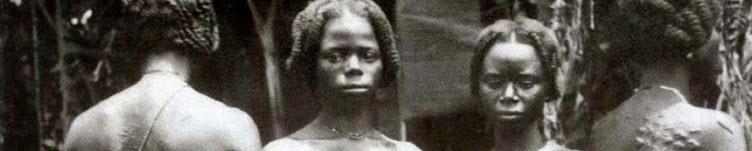
Le peuple punu est bien connu comme maîtrisant la sculpture des masques et des portes en bois. Le haut classicisme punu de l'art mélange idéalisme et réalisme.
L'architecture
Il y a l'architecture de l' ancien royaume d' Égypte et l'architecture du classicisme Kongo.
L'art visuel

l'art punu s'exprime au travers des sculptures et essentiellement au travers des céramiques qui expriment des figures géométriques. Il y a le pré-classicisme, le classicisme, le haut classicisme et le dernier classicisme.
Dibadi
Dibadi était le premier punu historien , il est un des plus grands conteurs. Il enregistrait beaucoup d'informations. Ses sujets impliquaient la guerre entre punu et étrangers, la répartition des clans punu. il restait remarquablement impartial et libre de tout préjudice nationaliste.
L'Age héroïque
Le XIV siecle ca 1350 représente l'age d'or punu.
La guerre contre les portugais. Le punu classicisme finit avec la victoire des Portugais en 1570 sous la conduite du gouverneur portuguais Gouveya qui inaugure l’ère de la colonisation.
La musique chez les punu
La musique joue un rôle important dans chaque aspect,de la vie punu. Les punu croyaient que la musique pouvait profondément affecter le comportement humain. La musique avait une place importante dans la vie publique et privée et elle était spécialement dans le contexte religieux. La musique punu était construite par une série de modes et de notes . Les instruments musicaux étaient le Ngomfi, sanza, le Moungongo, le tam tam et chaque corde du ngomfi avait son propre nom.
Il y avait des ballets opéra et le principal acteur était l' Harpiste .La science de l'harpiste et la science de la vibration, les chants avaient le ton des pleurs et des béatitudes.
La danse était d'une grande importance chez les punu, dans la période du classicisme punu la fonction de la danse était sociale et religieuse, la fameuse danse punu était l'Ikokou. Quant à leur structure, les chants, dénommés tumbu, sont antiphoniques, c'est-à-dire qu'ils évoluent dans une alternance entre soliste et chœur. Le chœur est composé de tous ceux qui sont présents à l’événement. Le rôle de soliste peut être assumé par toute personne qui en ressent l'envie. Il faut toutefois qu'elle ait une voix suffisamment puissante et une capacité d'insérer de nouvelles phrases en respectant la mélodie. Les personnes qui sont particulièrement douées pour le chant sont appelées des chanteurs (muwimbitji),
En littérature
Le Moumbouanga, les contes , les proverbes, poésie, palabre, théâtre formaient le corpus punu. Mueli était le premier génie de la littérature et de la tradition punu. Dans la littérature punu Maroundou représente la beauté et l'amour punu. Buanga le jeune héros représente le courage et la bravoure.


 “Long
ago, the people of the rainy, mountainous region of Verapaz were
trembling from the cold because they did not have clothes. From the
heavens, the goddess Itzam saw their suffering and came down to Earth.
She visited a woman in her house and tried to teach her how to weave,
but the woman simply did not understand. Just as the goddess was about
to give up, she saw a spider weaving its web. The deity told the woman
to watch how the spider worked, and thanks to this demonstration the
woman captured the essence of weaving.”
“Long
ago, the people of the rainy, mountainous region of Verapaz were
trembling from the cold because they did not have clothes. From the
heavens, the goddess Itzam saw their suffering and came down to Earth.
She visited a woman in her house and tried to teach her how to weave,
but the woman simply did not understand. Just as the goddess was about
to give up, she saw a spider weaving its web. The deity told the woman
to watch how the spider worked, and thanks to this demonstration the
woman captured the essence of weaving.”  Bats are
the guardians of the Underworld. They're considered suspicious
creatures, rich in dualities. The bat is worshipped for its rule over
the darkness, and is a powerful sign to mark against enemies. The Mayans
drew a very faint line between our concepts of good and evil: they were
seen in unison, rather than separation, and the bat is also revered for
its representation of this unison.
Bats are
the guardians of the Underworld. They're considered suspicious
creatures, rich in dualities. The bat is worshipped for its rule over
the darkness, and is a powerful sign to mark against enemies. The Mayans
drew a very faint line between our concepts of good and evil: they were
seen in unison, rather than separation, and the bat is also revered for
its representation of this unison. The butterfly,
with its wings spread, represents freedom. This freedom is sometimes
compared with that of the weaver, with her ability to weave wild stories
into her textiles. The white butterfly indicates good news and
positivity, while the black represents negativity, pain and tragedy. If a
black butterfly enters a Mayan home, it is caught and burned to rid the
house of the bad luck. Green butterflies are symbols of hope and are
welcomed into homes as omens of good health if a family member is sick.
The butterfly,
with its wings spread, represents freedom. This freedom is sometimes
compared with that of the weaver, with her ability to weave wild stories
into her textiles. The white butterfly indicates good news and
positivity, while the black represents negativity, pain and tragedy. If a
black butterfly enters a Mayan home, it is caught and burned to rid the
house of the bad luck. Green butterflies are symbols of hope and are
welcomed into homes as omens of good health if a family member is sick. The cross has
ties to both Mayan and Christian religion. The four points represent
the four directions of the winds, which give life to crops and mankind.
The Mayan cross is made from the four types of corn - white, yellow,
red, and black - which represent the parts of the human body. The cross
also signifies the dawn, the darkness, the water, and the air. This
symbol demonstrates the importance of the energies that come from each
extreme of the earth.
The cross has
ties to both Mayan and Christian religion. The four points represent
the four directions of the winds, which give life to crops and mankind.
The Mayan cross is made from the four types of corn - white, yellow,
red, and black - which represent the parts of the human body. The cross
also signifies the dawn, the darkness, the water, and the air. This
symbol demonstrates the importance of the energies that come from each
extreme of the earth. Corn
is a particularly important symbol in in Guatemalan textiles. Mayan
mythology tells that for the creation of the human being, white corn was
used for the bones, yellow corn for the muscles, black corn for the
eyes and hair, and red corn for the blood. For this reason, corn is not
just considered a source of food in rural areas: it's also part of the
ancestral, ceremonial traditions.
Corn
is a particularly important symbol in in Guatemalan textiles. Mayan
mythology tells that for the creation of the human being, white corn was
used for the bones, yellow corn for the muscles, black corn for the
eyes and hair, and red corn for the blood. For this reason, corn is not
just considered a source of food in rural areas: it's also part of the
ancestral, ceremonial traditions.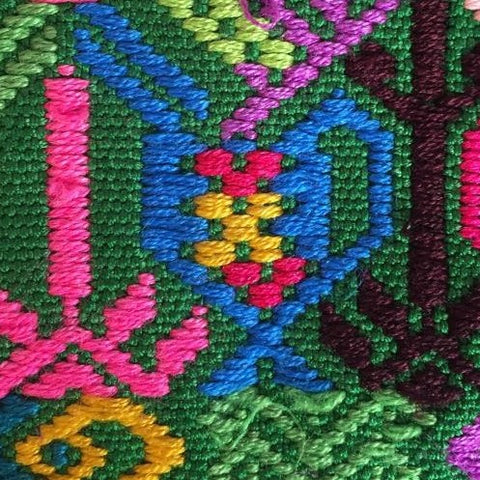 The cup
symbolises the importance of sharing with others. In modern Guatemala,
this symbol has becom a fusion of Mayan and Christian beliefs. It is
sometimes understood as the cup Jesus shared with the disciples during
the last supper.
The cup
symbolises the importance of sharing with others. In modern Guatemala,
this symbol has becom a fusion of Mayan and Christian beliefs. It is
sometimes understood as the cup Jesus shared with the disciples during
the last supper.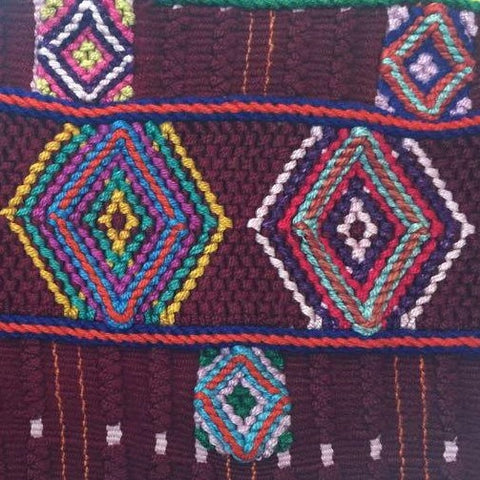 The diamond
is one of the most important symbols, and can be found in most of
Trama's products. It symbolises the arms of the weaver, with her body at
the bottom, and her textiles at the top.
The diamond
is one of the most important symbols, and can be found in most of
Trama's products. It symbolises the arms of the weaver, with her body at
the bottom, and her textiles at the top. Deer are
considered a symbol of strong, stable, regal energy by the Maya. They
represent all of the animal kingdom. Deer also encompass the four levels
of being: physical, mental, emotional and spiritual. The energies of
the deer also signify the binding forces between an individual and their
family.
Deer are
considered a symbol of strong, stable, regal energy by the Maya. They
represent all of the animal kingdom. Deer also encompass the four levels
of being: physical, mental, emotional and spiritual. The energies of
the deer also signify the binding forces between an individual and their
family.  Dolls
represent the connection between women, Mother Earth, and Ixchel, who
is the goddess of medicine, midwifery, the moon, and weaving.
Dolls
represent the connection between women, Mother Earth, and Ixchel, who
is the goddess of medicine, midwifery, the moon, and weaving. Doves are the Queens of the Heavens. These feminine birds provide nourishment for the Mayan people and renew the fruits of life.
 The ancient people understood the eagle’s
calls as a warning that an earthquake or storm was on its way. In
ancient Mayan mythology, one face of the double headed eagle represents
good and the other represents evil. The creature itself represents
contemplative thought. When focused upon, this symbol assists in
accessing inner wisdom and facilitates focus. Eagles have also
traditionally been a symbol of community and cooperative unity within a
diverse group. However, the meaning of the eagle changed during the
Spanish conquest since it was featured on the coat of arms of Charles V,
who was the ruler of the Spanish empire at the time. For the indigenous
population, the eagle can therefore also represent a cruel,
unforgiving, and unfamiliar being.
The ancient people understood the eagle’s
calls as a warning that an earthquake or storm was on its way. In
ancient Mayan mythology, one face of the double headed eagle represents
good and the other represents evil. The creature itself represents
contemplative thought. When focused upon, this symbol assists in
accessing inner wisdom and facilitates focus. Eagles have also
traditionally been a symbol of community and cooperative unity within a
diverse group. However, the meaning of the eagle changed during the
Spanish conquest since it was featured on the coat of arms of Charles V,
who was the ruler of the Spanish empire at the time. For the indigenous
population, the eagle can therefore also represent a cruel,
unforgiving, and unfamiliar being. The flower
motifs used in weaving are usually the native flowers of Guatemala,
like roses, lilies, violas, pansies, gladioli, and cactus flowers. All
of these flowers bloom abundantly throughout the year. The Mayans view
flowers as symbols of life and fertility.
The flower
motifs used in weaving are usually the native flowers of Guatemala,
like roses, lilies, violas, pansies, gladioli, and cactus flowers. All
of these flowers bloom abundantly throughout the year. The Mayans view
flowers as symbols of life and fertility. The inup
is the Tree of Life, which represents the life of man - birth, growth,
reproduction and death. It also indicates love, as shown in the union
between the two people who make up the two parts of the tree. The fruits
represent their offspring. Many sacred rites are performed under the
branches of these trees.
The inup
is the Tree of Life, which represents the life of man - birth, growth,
reproduction and death. It also indicates love, as shown in the union
between the two people who make up the two parts of the tree. The fruits
represent their offspring. Many sacred rites are performed under the
branches of these trees. Mayan Gods are frequently depicted with jaguar
attributes. The jaguar is said to have the ability to cross between
worlds, as represented by daytime and nighttime. The world of the living
and the earth are associated with the day, while and the spirit world
and the ancestors are associated with the night.
Mayan Gods are frequently depicted with jaguar
attributes. The jaguar is said to have the ability to cross between
worlds, as represented by daytime and nighttime. The world of the living
and the earth are associated with the day, while and the spirit world
and the ancestors are associated with the night. The lion
is often woven by young women to demonstrate a desire to be courted. As
the king of the jungle, the lion symbol is a keeper of goods, wealth,
and good luck. Sometimes the lion is read as a representation of anger,
and is therefore never used in huipils that are worn during happy
events.
The lion
is often woven by young women to demonstrate a desire to be courted. As
the king of the jungle, the lion symbol is a keeper of goods, wealth,
and good luck. Sometimes the lion is read as a representation of anger,
and is therefore never used in huipils that are worn during happy
events.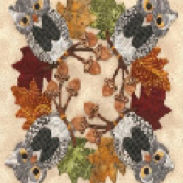 In Mayan mythology, the owl
is a symbol of death and destruction. These nocturnal birds of prey are
the mysterious messengers of dark powers. For the Quiche people, the
owl’s hoot is an omen of death.
In Mayan mythology, the owl
is a symbol of death and destruction. These nocturnal birds of prey are
the mysterious messengers of dark powers. For the Quiche people, the
owl’s hoot is an omen of death. The pitcher symbolises the head of a woman, from which her wonderful ideas for patterns and color combinations in textiles are poured.
 The quetzal is
the national bird of Guatemala, and one of the most important textile
symbols, often present in traditional clothing. In a number of modern
Mayan dialects, the name means ‘treasured’ or ‘sacred’. Legend has it
that long ago, the Quetzal would sing beautifully, but has been silent
since the Spanish conquest. The red chest is representative of the blood
spilled while the Mayan people tried to protect themselves and their
land.
The quetzal is
the national bird of Guatemala, and one of the most important textile
symbols, often present in traditional clothing. In a number of modern
Mayan dialects, the name means ‘treasured’ or ‘sacred’. Legend has it
that long ago, the Quetzal would sing beautifully, but has been silent
since the Spanish conquest. The red chest is representative of the blood
spilled while the Mayan people tried to protect themselves and their
land. The rooster,
like the turkey, is associated with marriage. In some Mayan
communities, proposals are accompanied by the groom's family presenting
the potential bride's family with between one and three roosters,
depending on how they regard their prospective daughter-in-law. Those
who receive three roosters can feel proud that the mother-in-law is
pleased with the union.
The rooster,
like the turkey, is associated with marriage. In some Mayan
communities, proposals are accompanied by the groom's family presenting
the potential bride's family with between one and three roosters,
depending on how they regard their prospective daughter-in-law. Those
who receive three roosters can feel proud that the mother-in-law is
pleased with the union. The serpent
appears frequently in Mayan textiles as a representation of the
representing the god Gucumatz, the creator of the world. This zigzag
design can also signify mountains, which provide clean air and
protection from sickness.
The serpent
appears frequently in Mayan textiles as a representation of the
representing the god Gucumatz, the creator of the world. This zigzag
design can also signify mountains, which provide clean air and
protection from sickness.  The sun
represents the radiant energy that contributes to the motion of the
universe. It's also symbolic of the god of corn, to whom the Maya pray
to ensure a good harvest.
The sun
represents the radiant energy that contributes to the motion of the
universe. It's also symbolic of the god of corn, to whom the Maya pray
to ensure a good harvest. Turkeys often
tell the stories of weddings. The turkey represents a proposal. Once a
Mayan couple are engaged, the groom’s family will spend the next two
years fattening up a turkey until the day of the wedding. The groom then
presents the dead turkey to the parents of his soon-to-be bride. If the
groom is rich enough, he will also give the bride’s family bread and
money.
Turkeys often
tell the stories of weddings. The turkey represents a proposal. Once a
Mayan couple are engaged, the groom’s family will spend the next two
years fattening up a turkey until the day of the wedding. The groom then
presents the dead turkey to the parents of his soon-to-be bride. If the
groom is rich enough, he will also give the bride’s family bread and
money.